Friday, February 14, 2014

Take you home with me / Put you in my house

To state the obvious: I don't know anything, and my opinion is worthless.

That said, it's hard to argue with Clay Risen's observation that, "If a [bourbon] bust comes, it will hit the craft sector hardest." But then, the bourbon boom is a very different experience for the big distilleries than for the small ones.

Speaking for myself, a key way the bourbon boom helps craft distillers is that it accustoms bourbon buyers (by which I mean me) to prices in the $40-$80 range. Craft distillers need buyers to pay $40 until the distillers are able to make bourbon that, tasted blind, is worth $40. (Adjust the prices to your local market.) So, while the boom allows the major distilleries to make a nice profit, it's pretty much essential to the craft distilleries for their continued existence.

I think we can also distinguish between a boom -- now measurable in billions of dollars -- and a fashion, the latter a matter of barrel-aged locophilic cocktails and the like. When something is in fashion, the quality is a secondary consideration, but sooner or later the fashions change.

In a few years, we will have a lot of small distilleries with enough stock and experience to be making high quality whiskey. Not all of them will, though, and the ones that haven't figured out how to do it will be bought out by Diageo go out of business, as consumers get tired of investing in what amounts to perpetual Kickstarter schemes. Such a winnowing of craft distilleries, if it comes, would occur even without a bourbon bust.

Or -- to put it in happier terms -- maybe craft distilleries will follow craft beer, not so much with an extinction cycle as by becoming unremarkably common. Maybe they survive the fashion of overpaying for underaged whiskey, get their value and cost better aligned, and settle in as respectable local or regional distilleries.

(Though of course the comparison will always be inexact, not least because the major breweries don't make very good beer, and their not very good beer won't improve with aging and blending.)

Sunday, June 2, 2013

The Octave of Lagavulin

I understand that, for those not physically on Islay, Ardbeg Day is nothing but a marketing gimmick, a trick that turns a few cases of free whiskey into an international symphony of unsolicited publicity.
The official Ardbeg Day tasting glass.


But I also understand that I'm not likely to ever taste an Ardbeg Day release if I don't taste it free on or about Ardbeg Day. They're too expensive to buy untasted, and any bar that would have them would also have a hundred or two other Scotches closer to the top of my To Try List.

So when I got my Ardbeg Committee notice that Ardbeg Day would be observed in Washington, DC, on May 29, I promptly RSVP'ed -- on the off chance that I might be able to make it. About half of such things I wind up missing due to a minor, pop-up crisis of one sort or another, and for some reason the odds are even worse when it's an Ardbeg tasting. (Once I was actually at a tasting, and about two minutes before the Ardbeg girls were scheduled to start handing out samples, I got a call from my wife that the car had died and could I come pick her up.)

No surprise, then, when May 29 came and I couldn't get downtown in time for the tasting. Forget it, Jake. It's Ardbeg.

Surprise, however, when June 1 came and I saw an announcement posted the night before on the DC Whiskey Drinkers (And Other Local Spirits) Facebook page that Jack Rose Dining Saloon would be offering free pours of Ardbog that evening.

And what do you know, I made it.

Now, if you've never been to Jack Rose, you should know that, though named for an applejack drink, it is a whiskey bar. And by that I mean it arguably has the largest selection of whiskeys for purchase in the Western Hemisphere. I think 1,800 was the number I was told -- with plans to bring it up to 3,000 by this time next year (making it arguably the largest in the world).
It's a good thing -- for my liver, family life, and finances -- that this place is no closer than 30 minutes to my house.

So when I got there half an hour before the tasting was to begin, I didn't beguile the time with a daiquiri. At the upstairs open-air terrace bar, I ordered a Russell's Reserve 10 yo, neat, with a Victory Summer Love back. (Not particularly exotic, but see the comment about my To Try List above.)

Ceci n'est pas un bouteille de bourbon.
The afternoon in DC cracked 90 degrees, so the bourbon might have benefited from an ice cube. This is certainly a whiskey to warm your toes in winter. The flavor was fuller and richer and smoother than Wild Turkey 101, as you'd expect given the increased age and lower proof (90 vs. 101). But -- maybe it was the heat, maybe the beer was fighting the bourbon -- there was a note on the finish I wanted to call fruit cocktail syrup but had to call floral perfume that I did not like at all. I wouldn't buy a bottle until and unless I've tried it again and that perfume wasn't there.

While working on the bourbon, I asked the bartender if the Ardbeg tasting would be upstairs (where last year's Ardbeg Day was observed). He said no, downstairs was the serious whiskey room, then introduced me to Roberto Cofino, the saloon's Scotch Malt Whisky Advisor, who happened by just then.

Roberto and I talked for a couple of minutes. He said he thought Ardbog was much more special than last year's Ardbeg Day release, and that I should spend more time nosing it since it would be hard to go back and pick out the details once I've tasted it.

He asked me what sort of whiskies I liked, and I gave him my stock fumbling answer, "Oh, I don't know, Islay, you know, Laphroaig, don't you know," which gets me through most whiskey conversations but clearly didn't give the present company much to work with. In the event, he talked up Port Charlotte 6 and 10 as particularly successful Bruichladdie experiments. (Which was coincidental, since I cracked a bottle of Laddie 10 last week and have been trying to make sense of it -- on which point, Las Vegas Whisky (@LVWhisky) helped by suggesting it's a nice break from Springbank 10.)

When I finished the Russell's Reserve, I went downstairs, ordered a New Belgium Blue Paddle to hold a seat at the bar, then went to the back to grab my taste of Ardbog. I thought the nose was dry and phenolic, but not amped up to 11 the way some Ardbegs are. There was an undertone of young spirit, too, though reportedly it's all at least 10 years old.

The palate was plenty smoky, but not at all the baconbomb of some Ardbegs. Most notable for me was the sweetness, like rock candy, that belied the dryness of the nose. It finished sweet, and the too-soon empty glass smelled of sweet creamed corn. The bartender asked me what I thought of it, and I said, "It's a lot subtler than other Ardbegs." She agreed.

My overall impression: I very much enjoyed the small pour I had, and would enjoy the occasional dram in the future, but I don't feel too bad about leaving the buying of Ardbog bottles to those with larger budgets and greater enthusiasm.

The one picture in this post that I took myself is the most commercial of them all.

Having convinced myself that it would be de trop to snatch another free sample, I looked about at the other 1,798 whiskeys on offer. And because why not, I ordered an ounce of the Port Charlotte PC6 Cuairt-Beatha.

I suppose I should have known that, if Bruichladdie befuddles me over the course of several evenings at home, it's going to befuddle me in a single glass after a couple other whiskeys and beers. But this was definitely a good kind of befuddlement. I don't understand PC 6, but it tastes great. There's a lot of smoke and a lot of sweetness, with maybe a hint of a Lagavulin-like medicinal note. A few minutes and a little water brought blondies to the nose.

When the bartender asked, I said, "This is really, really good." And when Roberto came by, I stopped him and showed him the bottle (which at Jack Rose they leave in front of you to read like a cereal box) and we both agreed that it was really, really good.

My problem -- and "problem" may not be the mot juste here -- is that PC6 is at least one full step away from the whiskeys I'm used to. The good news is it's not a step in the direction of refinement, in which case I wouldn't be able to appreciate it until I worked my way up to it. It's more in the direction of flavor profile, which I can enjoy quite well even as I don't know where to place it on my internal whiskey map. And all that means is that I've got lots of exploring to do, to fill in the blank spots.

As I said, that isn't what we usually mean by a problem.

Saturday, May 25, 2013

Buy me a drink, sailor?

Two of the things that surprised me when I first started following whiskey blogs in earnest a couple of years ago were:
  1. Some whiskey bloggers get free, unsolicited samples sent to them.
  2. Some whiskey bloggers don't want free, unsolicited samples sent to them.
The first one isn't really surprising. Despite all the marketing legerdemain, whiskey production is the business of turning grain, yeast, water, and wood into money. The cost of free samples sent to bloggers must be a tiny fraction of the total promotional budget, all of which can be factored into the price of the whiskey. It wouldn't take too many sales to recoup the investment, and with core expressions a single sale could easily become steady sales for years to come.

Factor in the small number of relevant blogs -- with 8 bottles, you could send a sample to every English language whiskey blogger known to SKU -- and sending samples to whiskey bloggers makes a lot more sense to me than book publishers sending review copies to bloggers, and I've been getting review copies from book publishers for years.

I started reviewing books I got for free at my college newspaper; when reviewing for a grad school paper, I learned you can request specific books, and publishers will actually (sometimes) send them to you. For a while in the 1990s, I was sent boxes of random mystery novels to review for a tiny quarterly magazine. That taught me two important lessons: first, there most certainly are books that deserve to be burned; and second, getting a free review copy in no way obligates the receiver to so much as read the book, much less write a favorable review.

I admit I was surprised when I started getting emails from publishers asking if I wanted books to review for the blog I started in 2002. How many of my dozen readers were going to buy the book anyway? But I'd spent enough time with writers to know everything in the publishing business is nuts, and if someone was willing to waste a book on the likes of me, so be it.

All this may be why I never would have predicted that some whiskey bloggers don't want free whiskey samples. I wouldn't say nice things about a book I didn't like just to keep getting books from the publisher, much less as quid pro quo for the review copy itself. Why would I, or anyone else, do something like that for a few bucks a year worth of free whiskey?

But a segment of the whiskey blogging world does think free samples at best give the appearance of a conflict of interest, and at worst produce reviews that might as well have been written by the marketing department. (A biased review is not the same as a blog post that literally was written by the marketing department -- i.e., that simply transcribes a press release; that sort of thing is, if nothing else, perfectly transparent.)

All this leads to the question raised by Matthijs Hakfoort of @VattedBlog and the blog Vatted in a conversation we had on Twitter the other day: Are whiskey fans too strict or book fans too lenient toward reviewers?

First, I'd say most reasons to write a fluff book review hold whether or not the book is free. The key  relationship for the reader is with the author, not the publisher, and authors can as easily (and would just as soon) be buttered up by someone who bought their book at retail. A reviewer who wants to stay on a publisher's mailing list will start by only requesting those books they're likely to enjoy. If they don't like a book, it's easier to not post a review than to write a fake one; their blog readers won't know, and (in my experience at least) the publisher won't much care. (As I said, the business is nuts.)

In short, I don't see much of an angle in feigning enthusiasm for a book you got free, simply because you got it free.

Things may be different for whiskey reviewers. There may be particular whiskies that one must review if one is a player in the whiskey blogosphere; there are certainly nine-days-wonder whiskies that all the cool kids seem to talk about at the same time. If you are sent three or four samples in the same range, I suppose you'd feel odd just reviewing the two or three you genuinely like. Promotional departments may have quicker hooks in the whiskey industry than in publishing. The reviews themselves are highly subjective, so it might be hard to tell when someone gives an 89 to a whiskey they really consider a 75. There's certainly more of a cachet to reviewing a sample of whiskey that retails for $200 and is only sold in duty free shops than to reviewing a book you can read for free tomorrow at the library.

Sunday, May 19, 2013

The elephant in the tasting room

I've read a lot of gloomy predictions recently. People who know a lot more about these things than I do are saying that whiskey enthusiasts are in for a tough time, as emerging markets, speculators, and trend-followers with more money than sense provide a market for distillers to sell worse whiskey for more money.

This is, of course, a very different angle on the Whiskey Renaissance than I get from popular articles written around a private tasting with a master distiller. Those all stress excitement and experimentation and new ideas and creative ways to keep up with demand.

You'd expect the folks making more money to be happier about the direction the whiskey business is headed than the folks spending more money. The blind man at the front of the elephant has a much different experience than the blind man at the rear.
Even decanters favor the front end.

For my part, I think my own ignorance, inexperience, and low standards will serve me well. Ten and fifteen years ago, which I'm told was a great time to be into Scotch, I was buying a bottle a year whether I needed it or not. I don't have the historical perspective to resent having to pay $40 or $50 for a 10 y.o. single malt; I just don't do it very often, and almost never without having tasted it before. (As for the price explosion on the higher end stuff, I frankly wouldn't have paid the old price of $120 (or $300) anyway, so the new price of $180 (or $900) doesn't really confront me. When I crack the bottle of Talisker 18 I got for $42, I'll just do so with the expectation that I won't be replacing it when it's gone.)

With American whiskey, there's a large and growing selection available for less than $50 -- and a fair number of decent whiskeys for less than $20. I can play very happily in this shallow end of the pool, if only because I've never really been in the deep end. And while few of the craft whiskeys are good value for the money in the blind tasting sense, I enjoy trying them and look at it as an investment in better whiskey to come.

So while an Iron Age of Whiskey Exploration may be upon those at the back end of the whiskey business elephant, I think I can still hope to manage a bit of a Silver Age of Whiskey Enjoyment.

Sunday, April 7, 2013

Weekend Whiskey Buying Guide: the basics

I went to the liquor store yesterday under nearly ideal conditions. I had plenty of time, only a vague sense of what I had plenty enough of at home, and no particular budget.

It took me more than half an hour to pick out three pretty ordinary bottles, much of that time spent waiting for reviews of on-sale items to download from Whisky Connosr.
Tax preparation software.

While I was weighing my options, another shopper walked passed me pushing a shopping cart. Without breaking strike, he pulled a 1.5 liter bottle of Dewars White Label off the shelf.

This led to the creation of the following partial decision tree for buying whiskey:

Prudence in whiskey buying: You gotta start somewhere.

It also solidified my impression that I'm pretty solidly in the 90th percentile when it comes to whiskey. I'd expect to know more about, spend more on, and drink more (or at least better) whiskey than the other nine if I were in a group of ten random people. And I'd expect to know the least about, spend the least on, and drink the least and worst whiskey of everyone if I were in a group of ten whiskey fans. (A corollary: I'm about as ignorant a whiskey blogger as bothers to blog about whiskey.)

That works out pretty well, since the vast majority of whiskey fans (and whiskey bloggers) just like to drink and talk (and occasionally swap) whiskey, with whoever else wants to drink and talk and swap whiskey. What snobbery there is -- as against ice, or blends -- usually indicates ignorance, and the rest is along the lines of my flowchart above, more of an exhortation to drink better (which can usually be done for about the same, and sometimes a better, price) than a belittling of Those Not In the Know.

Wednesday, February 20, 2013

Impressively hazed: Russell's Reserve Single Barrel coming soon

I've been asked to mention on my blog that the new Russell's Reserve Single Barrel should start showing up in stores within a month. I agreed, because frankly anyone looking to this blog as a conduit of the latest industry news needs all the help he can get.

No, I agreed because RRSB sounds like just the sort of bourbon I'd like to see more of: non-chill filtered, a proof you can do something with (110, in this case), at a reasonable price point (MSRP of $49.99).
You'd already know about this if you prowled the TABC label website.
My favorite part of the press release is the attempt to turn what I've always heard is a marketing problem into a marketing angle:
By avoiding the chill-filtration process, the whiskey is bottled with more flavor compounds and a deeper color which is denoted by an impressive haze when ice or chilled water is added.
I can see where "a disconcerting haze" wouldn't have struck the right note for consumers.

I haven't tasted RRSB yet; Weekend Whiskey isn't exactly an unsolicited-samples-in-the-mail-type operation. But I am looking forward to trying it, and I hope even more distilleries are working on similar products.

Sunday, February 3, 2013

Weekend Whiskey's Pub Crawl for Those Not Insisting on Exercise

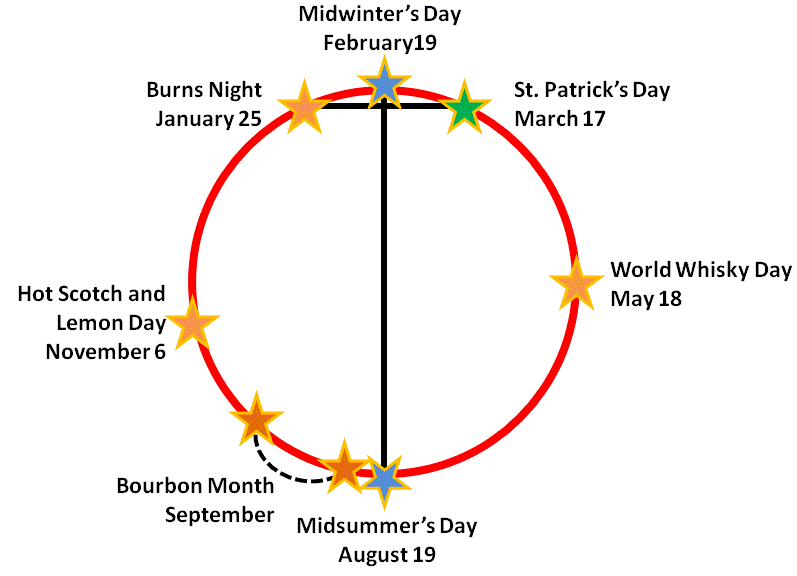
Last year, I proposed a whiskey calendar
whose key dates are November 30 and March 17 -- St. Andrew's Day and St. Patrick's Day, respectively. As you know, St. Andrew's Day is particularly well-suited for drinking Scotch whisky, and St. Patrick's Day for drinking Irish whiskey.
That idea fell flat, but I haven't given up on it altogether.

The whole point of keying on those dates was to celebrate the midpoint by drinking both Scotch and Irish whiskies. But the midpoint between Sts. Andrew & Patrick Days is January 23, and Scotch drinkers aren't going to be thinking about drinking Irish whiskey 2 days before Burns Night.

So this year I'm tweaking things, and proposing the key dates be Burns Night itself -- January 25 -- and St. Patrick's Day. That puts Midwinter's Day on February 19. Adding a few other dates throughout the year gives you this:


Now, as it happens, there is both a Scottish pub and an Irish pub just a couple of miles from me. (And by "as it happens," I mean, "the reason for this whole 'whiskey calendar' nonsense.") What better way to celebrate Midwinter's Day than a pub crawl from the one to the other?

Or, more precisely, to celebrate Midwinter's Weekend, since February 19 is a Tuesday this year and some of us have to be at work the next morning.

So I plan on heading to the Royal Mile Pub for a Scotch whisky around 1 pm on Saturday, February 16, and after a suitable period of time walking the half-block to the Limerick Pub for an Irish whiskey. (All quantities are approximate.)

The blue awning of the Royal Mile Pub, as seen from the front entrance of the Limerick Pub.
Granted, as pub crawls go this one doesn't require much in the way of leg strength. But love of whiskey isn't limited to the natural born hikers among us -- nor, for that matter, to those with an infallible sense of direction.