Saturday, May 25, 2013

Buy me a drink, sailor?

Two of the things that surprised me when I first started following whiskey blogs in earnest a couple of years ago were:
  1. Some whiskey bloggers get free, unsolicited samples sent to them.
  2. Some whiskey bloggers don't want free, unsolicited samples sent to them.
The first one isn't really surprising. Despite all the marketing legerdemain, whiskey production is the business of turning grain, yeast, water, and wood into money. The cost of free samples sent to bloggers must be a tiny fraction of the total promotional budget, all of which can be factored into the price of the whiskey. It wouldn't take too many sales to recoup the investment, and with core expressions a single sale could easily become steady sales for years to come.

Factor in the small number of relevant blogs -- with 8 bottles, you could send a sample to every English language whiskey blogger known to SKU -- and sending samples to whiskey bloggers makes a lot more sense to me than book publishers sending review copies to bloggers, and I've been getting review copies from book publishers for years.

I started reviewing books I got for free at my college newspaper; when reviewing for a grad school paper, I learned you can request specific books, and publishers will actually (sometimes) send them to you. For a while in the 1990s, I was sent boxes of random mystery novels to review for a tiny quarterly magazine. That taught me two important lessons: first, there most certainly are books that deserve to be burned; and second, getting a free review copy in no way obligates the receiver to so much as read the book, much less write a favorable review.

I admit I was surprised when I started getting emails from publishers asking if I wanted books to review for the blog I started in 2002. How many of my dozen readers were going to buy the book anyway? But I'd spent enough time with writers to know everything in the publishing business is nuts, and if someone was willing to waste a book on the likes of me, so be it.

All this may be why I never would have predicted that some whiskey bloggers don't want free whiskey samples. I wouldn't say nice things about a book I didn't like just to keep getting books from the publisher, much less as quid pro quo for the review copy itself. Why would I, or anyone else, do something like that for a few bucks a year worth of free whiskey?

But a segment of the whiskey blogging world does think free samples at best give the appearance of a conflict of interest, and at worst produce reviews that might as well have been written by the marketing department. (A biased review is not the same as a blog post that literally was written by the marketing department -- i.e., that simply transcribes a press release; that sort of thing is, if nothing else, perfectly transparent.)

All this leads to the question raised by Matthijs Hakfoort of @VattedBlog and the blog Vatted in a conversation we had on Twitter the other day: Are whiskey fans too strict or book fans too lenient toward reviewers?

First, I'd say most reasons to write a fluff book review hold whether or not the book is free. The key  relationship for the reader is with the author, not the publisher, and authors can as easily (and would just as soon) be buttered up by someone who bought their book at retail. A reviewer who wants to stay on a publisher's mailing list will start by only requesting those books they're likely to enjoy. If they don't like a book, it's easier to not post a review than to write a fake one; their blog readers won't know, and (in my experience at least) the publisher won't much care. (As I said, the business is nuts.)

In short, I don't see much of an angle in feigning enthusiasm for a book you got free, simply because you got it free.

Things may be different for whiskey reviewers. There may be particular whiskies that one must review if one is a player in the whiskey blogosphere; there are certainly nine-days-wonder whiskies that all the cool kids seem to talk about at the same time. If you are sent three or four samples in the same range, I suppose you'd feel odd just reviewing the two or three you genuinely like. Promotional departments may have quicker hooks in the whiskey industry than in publishing. The reviews themselves are highly subjective, so it might be hard to tell when someone gives an 89 to a whiskey they really consider a 75. There's certainly more of a cachet to reviewing a sample of whiskey that retails for $200 and is only sold in duty free shops than to reviewing a book you can read for free tomorrow at the library.

Sunday, May 19, 2013

The elephant in the tasting room

I've read a lot of gloomy predictions recently. People who know a lot more about these things than I do are saying that whiskey enthusiasts are in for a tough time, as emerging markets, speculators, and trend-followers with more money than sense provide a market for distillers to sell worse whiskey for more money.

This is, of course, a very different angle on the Whiskey Renaissance than I get from popular articles written around a private tasting with a master distiller. Those all stress excitement and experimentation and new ideas and creative ways to keep up with demand.

You'd expect the folks making more money to be happier about the direction the whiskey business is headed than the folks spending more money. The blind man at the front of the elephant has a much different experience than the blind man at the rear.
Even decanters favor the front end.

For my part, I think my own ignorance, inexperience, and low standards will serve me well. Ten and fifteen years ago, which I'm told was a great time to be into Scotch, I was buying a bottle a year whether I needed it or not. I don't have the historical perspective to resent having to pay $40 or $50 for a 10 y.o. single malt; I just don't do it very often, and almost never without having tasted it before. (As for the price explosion on the higher end stuff, I frankly wouldn't have paid the old price of $120 (or $300) anyway, so the new price of $180 (or $900) doesn't really confront me. When I crack the bottle of Talisker 18 I got for $42, I'll just do so with the expectation that I won't be replacing it when it's gone.)

With American whiskey, there's a large and growing selection available for less than $50 -- and a fair number of decent whiskeys for less than $20. I can play very happily in this shallow end of the pool, if only because I've never really been in the deep end. And while few of the craft whiskeys are good value for the money in the blind tasting sense, I enjoy trying them and look at it as an investment in better whiskey to come.

So while an Iron Age of Whiskey Exploration may be upon those at the back end of the whiskey business elephant, I think I can still hope to manage a bit of a Silver Age of Whiskey Enjoyment.

Sunday, April 7, 2013

Weekend Whiskey Buying Guide: the basics

I went to the liquor store yesterday under nearly ideal conditions. I had plenty of time, only a vague sense of what I had plenty enough of at home, and no particular budget.

It took me more than half an hour to pick out three pretty ordinary bottles, much of that time spent waiting for reviews of on-sale items to download from Whisky Connosr.
Tax preparation software.

While I was weighing my options, another shopper walked passed me pushing a shopping cart. Without breaking strike, he pulled a 1.5 liter bottle of Dewars White Label off the shelf.

This led to the creation of the following partial decision tree for buying whiskey:

Prudence in whiskey buying: You gotta start somewhere.

It also solidified my impression that I'm pretty solidly in the 90th percentile when it comes to whiskey. I'd expect to know more about, spend more on, and drink more (or at least better) whiskey than the other nine if I were in a group of ten random people. And I'd expect to know the least about, spend the least on, and drink the least and worst whiskey of everyone if I were in a group of ten whiskey fans. (A corollary: I'm about as ignorant a whiskey blogger as bothers to blog about whiskey.)

That works out pretty well, since the vast majority of whiskey fans (and whiskey bloggers) just like to drink and talk (and occasionally swap) whiskey, with whoever else wants to drink and talk and swap whiskey. What snobbery there is -- as against ice, or blends -- usually indicates ignorance, and the rest is along the lines of my flowchart above, more of an exhortation to drink better (which can usually be done for about the same, and sometimes a better, price) than a belittling of Those Not In the Know.

Wednesday, February 20, 2013

Impressively hazed: Russell's Reserve Single Barrel coming soon

I've been asked to mention on my blog that the new Russell's Reserve Single Barrel should start showing up in stores within a month. I agreed, because frankly anyone looking to this blog as a conduit of the latest industry news needs all the help he can get.

No, I agreed because RRSB sounds like just the sort of bourbon I'd like to see more of: non-chill filtered, a proof you can do something with (110, in this case), at a reasonable price point (MSRP of $49.99).
You'd already know about this if you prowled the TABC label website.
My favorite part of the press release is the attempt to turn what I've always heard is a marketing problem into a marketing angle:
By avoiding the chill-filtration process, the whiskey is bottled with more flavor compounds and a deeper color which is denoted by an impressive haze when ice or chilled water is added.
I can see where "a disconcerting haze" wouldn't have struck the right note for consumers.

I haven't tasted RRSB yet; Weekend Whiskey isn't exactly an unsolicited-samples-in-the-mail-type operation. But I am looking forward to trying it, and I hope even more distilleries are working on similar products.

Sunday, February 3, 2013

Weekend Whiskey's Pub Crawl for Those Not Insisting on Exercise

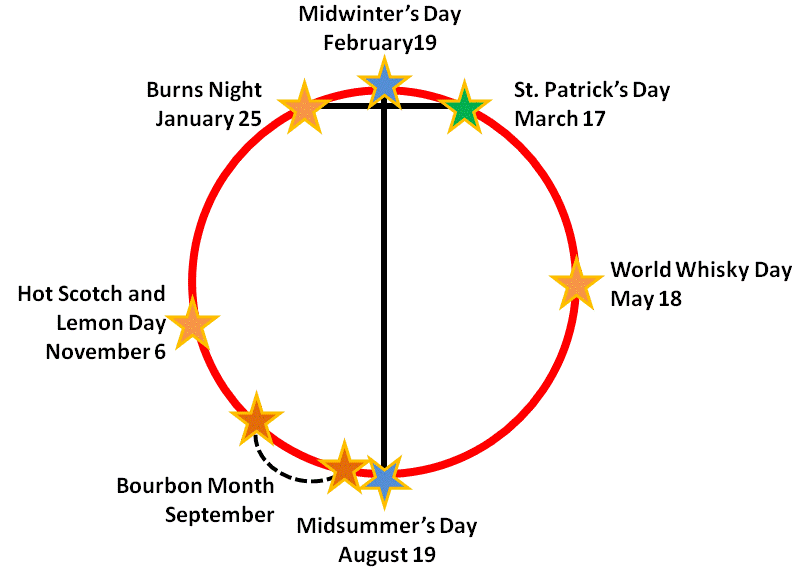
Last year, I proposed a whiskey calendar
whose key dates are November 30 and March 17 -- St. Andrew's Day and St. Patrick's Day, respectively. As you know, St. Andrew's Day is particularly well-suited for drinking Scotch whisky, and St. Patrick's Day for drinking Irish whiskey.
That idea fell flat, but I haven't given up on it altogether.

The whole point of keying on those dates was to celebrate the midpoint by drinking both Scotch and Irish whiskies. But the midpoint between Sts. Andrew & Patrick Days is January 23, and Scotch drinkers aren't going to be thinking about drinking Irish whiskey 2 days before Burns Night.

So this year I'm tweaking things, and proposing the key dates be Burns Night itself -- January 25 -- and St. Patrick's Day. That puts Midwinter's Day on February 19. Adding a few other dates throughout the year gives you this:


Now, as it happens, there is both a Scottish pub and an Irish pub just a couple of miles from me. (And by "as it happens," I mean, "the reason for this whole 'whiskey calendar' nonsense.") What better way to celebrate Midwinter's Day than a pub crawl from the one to the other?

Or, more precisely, to celebrate Midwinter's Weekend, since February 19 is a Tuesday this year and some of us have to be at work the next morning.

So I plan on heading to the Royal Mile Pub for a Scotch whisky around 1 pm on Saturday, February 16, and after a suitable period of time walking the half-block to the Limerick Pub for an Irish whiskey. (All quantities are approximate.)

The blue awning of the Royal Mile Pub, as seen from the front entrance of the Limerick Pub.
Granted, as pub crawls go this one doesn't require much in the way of leg strength. But love of whiskey isn't limited to the natural born hikers among us -- nor, for that matter, to those with an infallible sense of direction.

Sunday, January 27, 2013

Friday in the park with George

On a recent business trip, I happened through Lynchburg, Tennessee. Naturally, I took advantage of the opportunity to visit the George Dickel Distillery, about half an hour to the north.

The George Dickel Distillery is, as they say on their website, "a ways off the beaten path," though even the last two miles down Cascade Hollow Road aren't too backwoods-country windy. (But then, I've taken more than one "short cut" down a logging road in my day.) When you come to the end of the road, the visitor center is on your left and the distillery on your right. The visitor center is done up in authentic Olde Tyme General Store, which both suits their image and suggests that some of what you'll hear on the tour will be... just as authentic.

Tennesseans of the 1880s were a hardy lot, needing only provisions of shot glasses and T-shirts.
The olde tyme angle plays up the history of whiskey distilling in Cascade Hollow, although George Dickel's own distillery (est. 1870) was a mile or so up and yonder from the current site, closer to Cascade Springs that provided the water. What for a while was the state's largest distillery had to close in 1911 (Tennessee was ahead of the national Prohibition curve), and when Schenley Distillers Corp., which owned the Dickel name (and, reportedly, the Dickel recipe and even yeast strains), decided to reopen it in 1958, they picked the current site (though they still use water from Cascade Springs).

When I arrived, on a sunny Friday morning just after 9:30, I was the only visitor. The tour guide on duty pointed me to an olde tyme rocking chair, where I watched a short video about the history of the distillery and what makes Dickel different from other sippin' whiskies. (You can watch it, too! "George Dickel - The Man & His Vision" is on this web page, along with a lot more information about the distillery than you'll read in my post.)

By 10 a.m., I was still the only visitor, so I got a private tour. (In fact, the tourist was outnumbered by the guides, since we were joined by a tour guide trainee.)

Getting a private tour was nice, since I got to ask any question that occurred to me, when it occurred to me. The downside was a certain awkwardness when some bit of tour guide schtick called for an appreciative murmur from the tourists and all I could muster was a nod and a smile.

The George Dickel Distillery. Rickhouse is back up the hill a ways. Bottling facility is past that, about 300 miles.
Now, I did not take notes, and most of the numbers were lost on me as soon as they were spoken, but the general process for making George Dickel Tennessee Sour Mash Whisky is this: Using a mashbill of 84% corn, 8% rye, and 8% malted barley, the grains are ground, cooked, and fermented in the usual sort of way. Then the wash is distilled in a column still, with the resulting low wines distilled a second time in a pot still.

Next comes the step that Dickel says makes a whiskey Dickel: chill filtering. Yes, I know chill filtering is supposed to be naughty, but as the story goes,"George A. Dickel discovered that whisky made during the winter was smoother than whisky made in the summer. So, George Dickel is the only Tennessee whisky to chill the whisky [to 40 deg F] before it goes into the charcoal mellow-ing vats. This filters out the oils and fatty acids inherent in most whisky products."

The charcoal is made by bonfire in a field across the road, up from the visitor center, then ground into pellets and packed in a vat between perforated steel plates and wool blankets. The chilled whiskey takes a week or ten days to filter through, after which it's barreled and taken up a side road to the warehouses.

Woot.
The warehouses (single story, and no, they don't rotate the barrels around) are not part of the tour, though they've redone part of their old bottling building as a mockup of a warehouse. This, apparently, is ideal for pictures, which I learned when I was told that they'd take my picture standing in front of the empty barrels if I wanted. I didn't want to hurt anyone's feelings, so I said yes please. That's why I have a picture of me standing in front of empty barrels. I suppose this is a variant of, "Do you want a picture of yourself standing in front of the still?" which I've been asked at a couple of microdistilleries. (And I don't, particularly; they aren't my stills.)

I mentioned their old bottle building. They don't have a new one, for reasons of economics. Though their Tennessee Whisky is all distilled, aged, and blended in Cascade Hollow, not a drop of it is bottled there. It's all loaded into tankers and shipped to an out-of-state bottling plant; currently they're using one in Indiana. (If you're driving between Tullahoma and Indianapolis and you see a milk truck with a "FLAMMABLE" sign, make friends with the driver.)

The worst part of the tour was the walk (in beautiful sunshine) back to the visitor center. Worst because of what we passed on the way. Of all sad words of tongue or pen, surely, "And our brand new tasting house should be open in a few weeks," is in the top ten.

Even the camera phone had something in its eye.
To take my mind off that, my guide pointed out a couple of blackened trees right next to the distillery's exhaust vents (they've visible on the far right of the picture of the distillery). He gave me the helpful advice that, should I ever be tramping through the forests of Tennessee and come across trees covered in Baudonia fungus, I should hightail it out of there before the moonshiners return.

So, what about the whiskies? Well, there's Old No. 8, "the classic whisky that made George Dickel famous," blended from barrels aged six to eight years, give or take. No. 12 is bottled at 90 proof from, say, ten to twelve year old barrels. Barrel Select is a small-batch whiskey of ten or so barrels aged ten to twelve years.

And let's not forget Cascade Hollow, which I assume is their entry-level whiskey. I assume that, rather than assert it, because the tour guide forgot to mention that it existed. I'm not 100% sure it was for sale in their shop, and I didn't even realize they still made it until I saw it on their website.

We did get to chat about the new George Dickel rye, which I think was just released in December. Turns out it's a 95% rye distilled in Lawrenceburg, Indiana -- stop me if you've heard this one. Still, their position is that it's a bona fide Dickel whiskey because it's chill filtered. I suppose the truth is in the taste.

Speaking of taste, as intimated above, I didn't get a chance -- though I do have a tweet from last year, when I bought a No. 8 miniature and tried it in a plastic cup in a hotel room one night: "green apple gives way to caramel on the nose, woody corn w/ light mouthfeel.Touch of charcoal in finish. Is its own TN whisky." That last bit meaning, of course, that they aren't trying to copy Jack Daniel's.

UPDATE: Can a visitors center, a movie, a tour guide, and a website all lie about George Dickel's actual involvement in distilling whiskey? Yes.

Saturday, January 26, 2013

The Mild Rover

A few weeks back, my wife told me she and our younger son were going away for the weekend.

Now, a weekend to myself -- where I can go and do whatever fool thing strikes my fancy, without risking the need to explain why on earth I'd want to do it -- is a rare treat. (Strictly speaking, it wasn't a weekend to myself, as our older son would be around. But having a high school senior is sort of like having a cat; once he's fed and watered, you don't see much of him, and if he does get out of the house you just need to make sure he gets back inside before you go to bed.)

Naturally, I began asking myself, "What will I drink, and where will I drink it?" Which is to say, "Beer or Whiskey?" and "North toward Baltimore or south toward Washington?"

As questions go, neither of these is particularly vexing, but the answers do make for a very different afternoon.

Beer or Whiskey?

Life is hard enough without making it worse with false dilemmas. There are at least three bars within easy driving distance of me (I really mean easy driving home distance; these days I'm no't so much buzzed after a few drinks as ready for a nap after two) whose owners are big fans of both craft beer and good whiskey.

But if I'm set on beer and I have all day, I'm going to head to one of the many taphouses and beer pubs I've heard about but never been in. And if it's whiskey, well, I've got a list of untried bars for that, too.

North or South?

I live about six miles north of Washington, but I cross the border so rarely I always feel like Lord Emsworth coming to London from Market Blandings. Once resolved to go there, of course, the whole city is open to me, including a number of good microbreweries, at least one world-class whiskey bar -- oh, and they have liquor stores there, too, with different and broader selections than I usually see out in the provinces.

This also puts me about 35 miles from downtown Baltimore, with one or two pockets of civilization on the way. A 70 or 80 mile round trip for a drink of something I can almost surely find within five miles of home is exactly the sort of thing bachelor Saturdays are made for.
It's funny because it's true. (Image from art.com.)

In the Event

So what did I wind up doing?

Well, feeding a teenage boy isn't difficult, but it is time consuming, in the sense that you have to wait until noon for him to wake up. It was past one in the afternoon before I deposited him at his girlfriend's house, which brought me within a mile or so of the District. So I headed into DC, still without a plan but generally thinking whiskey, and I wound up taking the tour at New Columbia Distillers. (Their Green Hat gin is relatively light on the pine sap, though it is still, when you get down to it, gin. The real point is that they're planning on a Maryland-style rye in the foreseeable future.)

New Columbia Distillers' granary, mill, wash tuns, stills, bottling plant, tasting room, and visitor center.
Then I had a very pleasant couple of drinks at the Quarry House Tavern, a bar near my house that I've been to several times with my wife (and one of the places I mentioned above, where the owners like both beer and whiskey). It bills itself as "Silver Spring's favorite dive," all of which is true, but for some reason I hadn't thought of it when casting about for a place to order a fine whiskey.

How many whiskies costing more than $200 a pour do you suppose are down these steps?
Finally, I capped off the evening with a bourbon while watching no-name horror movies on Netflix with my son.

All in all, it was a great day.